

Aparajita, also called butterfly pea or blue tea, makes a naturally caffeine-free drink. Its blue pigments work as antioxidants in lab tests. Claims about memory, stress, blood sugar, skin and hair come mostly from lab and animal studies, so they are possible but not proven. Enjoy it as a calm, colourful drink with no sugar needed.
If you’ve ever seen aparajita growing along a garden wall, you’ll probably remember the colour. Those deep blue flowers are hard to miss.
You might know the flower from your garden, from puja, or from the blue tea that’s become popular in cafés. It’s the same plant, and making tea from it is surprisingly simple. Add hot water to the dried flowers, leave them for a few minutes, and you have a bright blue drink. Add lemon, and the colour changes to purple.
But look up aparajita flower benefits, and you’ll find a lot more than tea recipes. It’s said to help with memory, reduce stress, improve skin and hair, and even manage blood sugar.
How much of that is true?
We looked into the research to find out what’s known about this familiar flower and where the evidence is still limited. Since we sell aparajita flower tea, we’ll also show you how to make it at home.
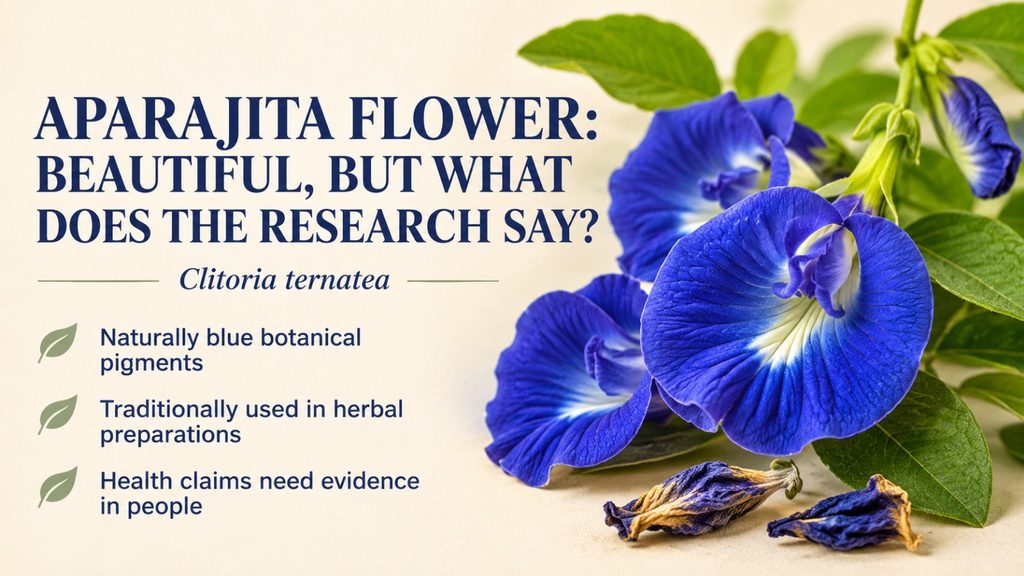
Aparajita Flower Benefits: What the Research Says
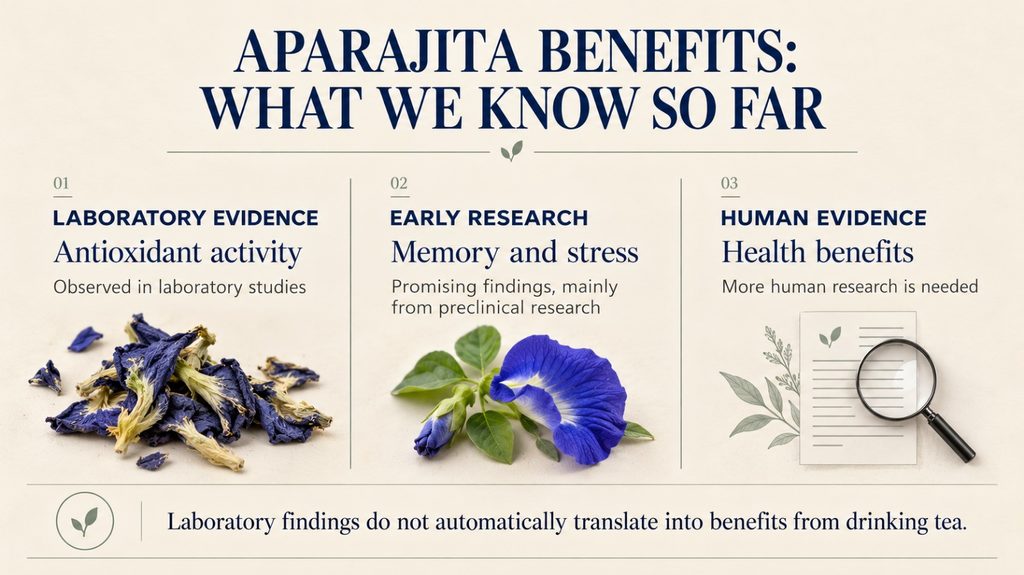
The antioxidant part is the best supported. Almost everything else comes from lab or animal studies, which means it’s interesting, but nobody has proven it in people. This review in the Journal of Ethnopharmacology collects a lot of that work if you’d like to read it yourself.
Butterfly pea flower benefits begin with those blue pigments. In lab tests, they work as antioxidants, which means they help to deal with free radicals, the unstable molecules your body makes all day. That part is real. What we can’t tell you is how much a cup of tea changes anything, because a test tube and your body aren’t the same thing.
Memory and stress are the claim people repeat the most. Ayurveda has used this plant for ages as a memory tonic and to calm the mind, and the 2008 review lists memory, anti-stress, and anti-anxiety effects. But as far as we could tell, those were mostly animal studies using strong extracts, not people drinking tea. So the clitoria ternatea benefits for the brain are possible, not proven.
Blood sugar shows up in the reviews too, under antidiabetic activity, but there isn’t much human data. If you have diabetes, don’t swap anything your doctor gave you for this tea.
On skin and hair, the reviews we read don’t show that drinking aparajita tea grows hair or clears skin. It sounds believable because of the antioxidants, but nobody has shown it.
And blue tea for weight loss? Nothing we read says it makes you lose weight. What it can do is replace a sugary drink. It has no caffeine and almost no calories if you skip the sugar, and that swap does help. Detox is the same story. Your liver and kidneys already do that job.
Aparajita Flower Tea Benefits in Everyday Life
So what do you get from a cup of aparajita flower tea? A mild, slightly earthy drink with no caffeine and some antioxidants in it. That’s about it, and for most people that’s enough. You can have it at night without it keeping you awake. Squeeze some lemon in and the blue turns purple, which is fun to watch.
When people ask us about butterfly pea flower tea benefits, this is what we tell them. It’s an easy habit; it can replace something sweeter, and the antioxidants are a bonus. Don’t expect it to do what the studies on strong extracts did. One or two cups a day is what most people drink. If you like something more sour, try our hibiscus tea too.

How to Make Butterfly Pea Flower Tea
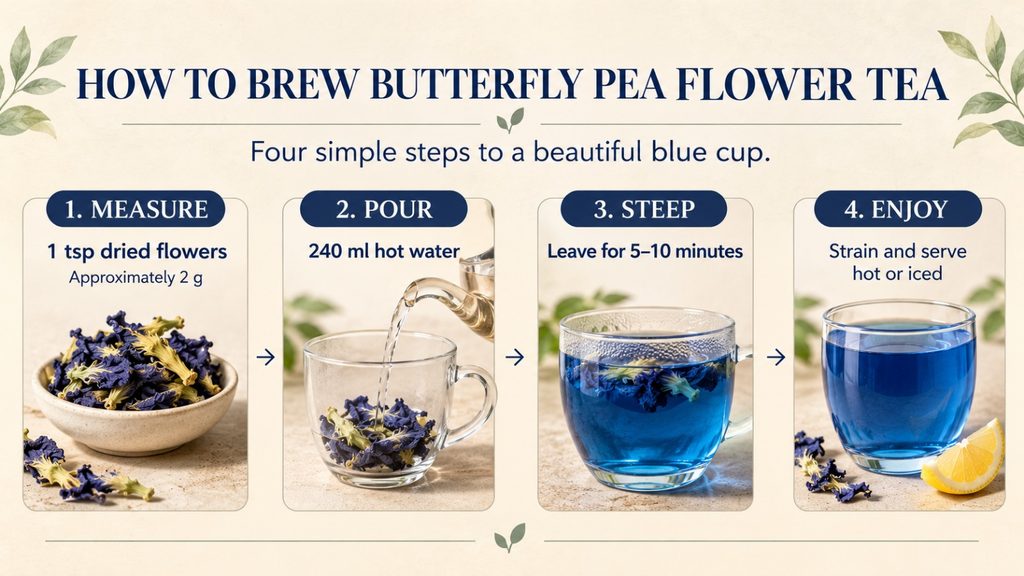
You don’t need a special teapot or any complicated ingredients. A cup, some dried flowers, and hot water are enough.
For one cup, use:
- 1 teaspoon of dried aparajita flowers, roughly 2 g
- 240 ml of water
- Honey or lemon, if you like
Put the flowers in a cup and pour over water that’s just come off the boil. Leave them to steep for 5 to 10 minutes, depending on how strong you like the colour and flavour.
Strain the flowers, and your tea is ready.
Want to drink it cold? Make the tea as usual, let it cool and pour it over ice. Add lemon if you like a little tartness.
One small tip: if you want to keep that striking blue colour, skip the milk. Lemon will change the colour, while milk makes the drink look less vivid.
If you’d like to try it at home, our dried aparajita flowers are whole, sun-dried butterfly pea flowers with nothing added.
What else can you do with aparajita flowers?
Apart from making tea, butterfly pea flowers are used to colour food and drinks. In parts of Southeast Asia, they’re added to rice, desserts and other dishes to give them a natural blue colour.
In India, the flower is also used in traditional practices and puja, including during festivals such as Navratri and Dussehra.
You’ll also come across it in traditional hair and skin remedies. These uses have a long history, although the research supporting specific cosmetic benefits is still limited.
Blue aparajita vs white aparajita: what’s the difference?
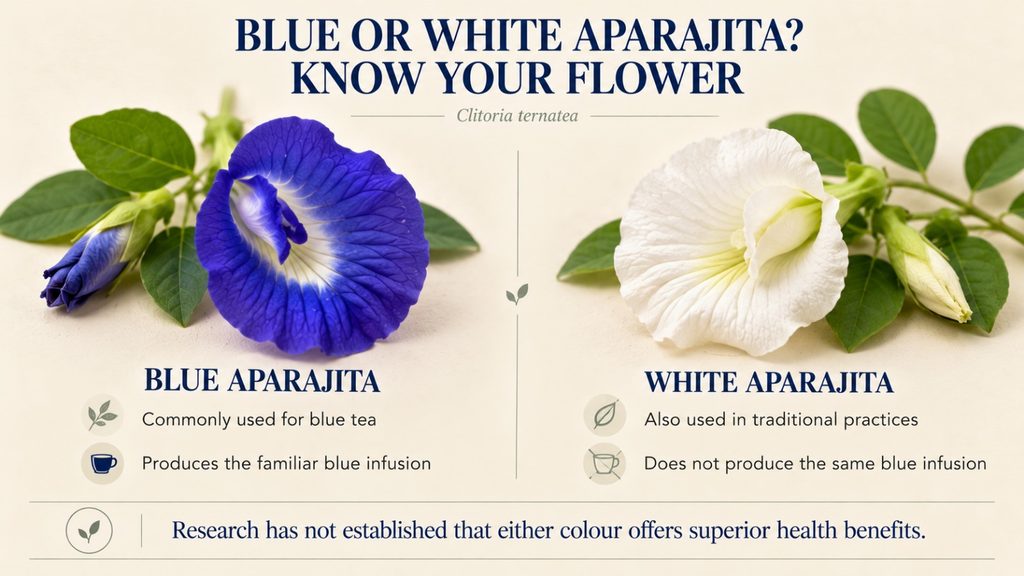
Aparajita flowers can be blue or white.
The blue variety is more commonly used for tea because it gives the drink its familiar colour. White aparajita is also used in traditional practices.
There’s limited research comparing the two varieties, so we can’t say that one is better than the other for health benefits. If you’re buying flowers specifically to make blue tea, choose the blue variety.
Is aparajita the same as shankhpushpi?
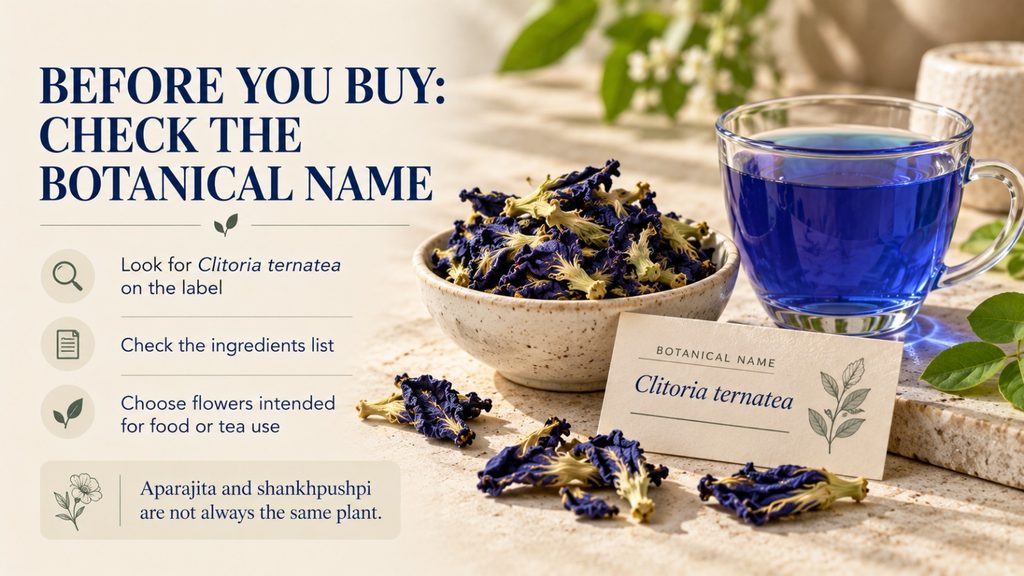
Not exactly. The confusion comes from the fact that shankhpushpi is a name used for several different plants.
Aparajita is Clitoria ternatea. Another plant, Convolvulus pluricaulis, is commonly identified as the main shankhpushpi in Ayurveda.
The two plants look quite different. Aparajita has distinctive blue, pea-shaped flowers, while Convolvulus pluricaulis has smaller, funnel-shaped flowers that are usually pale blue or white.
This distinction matters when buying herbal products because the name on the front of a pack doesn’t always tell you exactly which plant is inside.
If you’re looking specifically for butterfly pea flowers, check that the botanical name Clitoria ternatea appears on the label.
Who should be careful about drinking aparajita tea?
There’s still limited information about the safety of regular aparajita tea consumption in certain groups.
If you’re pregnant or breastfeeding, speak to your doctor before drinking it regularly. It’s also sensible to check first if you take medication or have an existing health condition.
If you take medication for diabetes, don’t use aparajita tea as a substitute for your prescribed treatment. The early blood sugar research isn’t enough to establish how the tea affects people taking these medicines.
Should you give aparajita tea a try?
If you like trying different herbal drinks, aparajita is worth exploring. It’s easy to make, has a mild flavour, and looks beautiful in a glass, especially with a squeeze of lemon.
Its traditional uses and early research make it an interesting flower to learn about, too. Just keep in mind that many of the health benefits you read about haven’t been established in people.
If you’d like to make a cup at home, our Butterfly Pea Flower Tea is made from sun-dried flowers from the foothills of Uttarakhand, with nothing added. The 25 g and 50 g packs start at ₹249.
You can find more details about the product and check our licences and quality before ordering. Free delivery across India and cash on delivery are available.
Have a question about the tea or how to brew it? Contact us and our team will be happy to help.
What is aparajita flower called in English?
It’s called butterfly pea or blue pea flower. Its botanical name is Clitoria ternatea. In Tamil, it’s known as sangu poo, and in Malayalam, shankupushpam.
Is aparajita the same as shankhpushpi?
Not exactly. Shankhpushpi is a name used for several plants. Aparajita is sometimes sold under that name, but Convolvulus pluricaulis is commonly identified as the main shankhpushpi.
What are the benefits of aparajita flower tea?
The tea is naturally caffeine-free and contains plant compounds such as anthocyanins. Research has explored its antioxidant activity and a possible effect on blood sugar. Claims about memory, stress, skin and hair need more human research.
Can I drink aparajita tea every day?
There isn’t enough research to establish a specific daily amount that’s suitable for everyone. Check the product instructions, and speak to your doctor before making it a regular habit if you’re pregnant, breastfeeding, taking medication or managing a health condition.
Is aparajita tea safe during pregnancy?
There isn’t enough reliable information to establish its safety during pregnancy. Check with your doctor before drinking it.
Does aparajita flower tea contain caffeine?
No. It’s made from dried butterfly pea flowers rather than tea leaves, so it’s naturally caffeine-free.

